DeCIRRA research project, subproject 3, final synthesis report 2026
DeCIRRA, ZHAW
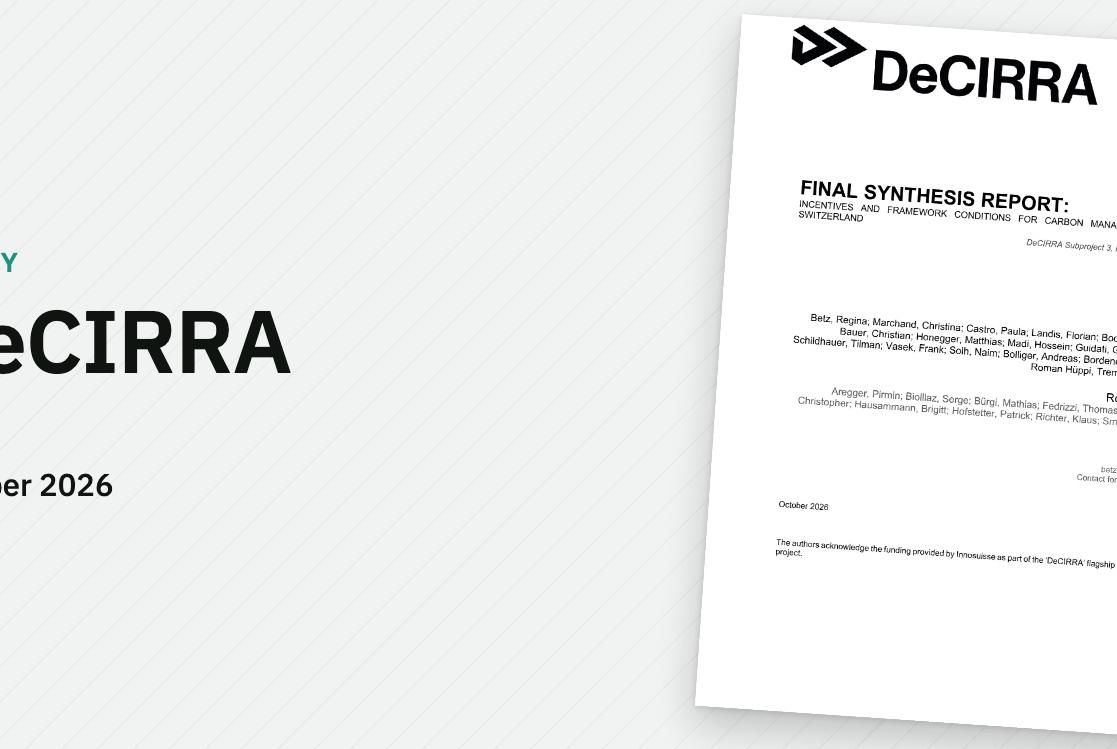
Which carbon management approaches does Switzerland need to reach net zero by 2050, and on which framework conditions do they depend? The final synthesis report of DeCIRRA subproject 3 answers with updated scenario modelling, a representative survey of 3,058 people and an analysis of business models. Regina Betz, Christina Marchand and Paula Castro of ZHAW led the editorial team. Frank Vasek and Naim Solh of Timber Carbon co-authored the chapter on timber construction.
Authors / institution
Regina Betz, Christina Marchand, Paula Castro (ZHAW, editorial team), Frank Vasek and Naim Solh (Timber Carbon), with authors from PSI, ETH Zurich and other partners
Published
2026
Timber construction comes first in every scenario
The report models four pathways to 2050: Octopus, Butterfly, Clam and Snail. In all of them, timber construction reaches its maximum modelled potential of about 2 Mt CO₂ per year. Together with biochar and CO₂ capture at biogas plants, it forms a no-regret cluster: available today, at technology readiness level 9 and independent of CO₂ transport infrastructure.
Domestic direct air capture is not part of the optimal mix in any scenario. Marginal abatement costs range from about CHF 220 per tonne CO₂e in Butterfly to CHF 1,500 in Clam, depending on the cost of CO₂ transport and storage infrastructure. Delay costs most: welfare losses in Snail are more than 2.5 times those in Butterfly. In the survey, around 88 % of respondents were neutral or supportive of CO₂ transport.
Timber in construction is the first-priority approach in every scenario, reaching its maximum modelled potential of about 2 Mt CO2 per year.
Accounting is the open question
According to the report, no approach has a commercial business case today without regulation, because carbon removal is a public good whose value policy has to assign. For timber construction, accounting and certification remain open. The report compares the HWP-pool approach behind «Senke Schweizer Holz» with project-level and value-chain approaches. It notes that the Swiss 30-year permanence requirement is out of step with international standards and calls for a structured comparison before the 2030 revision of Swiss climate policy.
How Timber Carbon sees it
Timber Carbon, launched in 2026 as a spin-off of Timber Finance, quantifies, certifies and monetises the carbon removed in mass timber buildings, building by building. The report names questions we work on, among them accounting at the end of a building's life and proof of additionality. The DeCIRRA poster on timber construction summarises the timber chapter, the Technology page sets out our current approach.
Full reference: Betz, R., Marchand, C., Castro, P., et al. (2026). Final synthesis report: Incentives and framework conditions for carbon management in Switzerland. DeCIRRA Subproject 3, Deliverable 3.4. ZHAW.
Topics