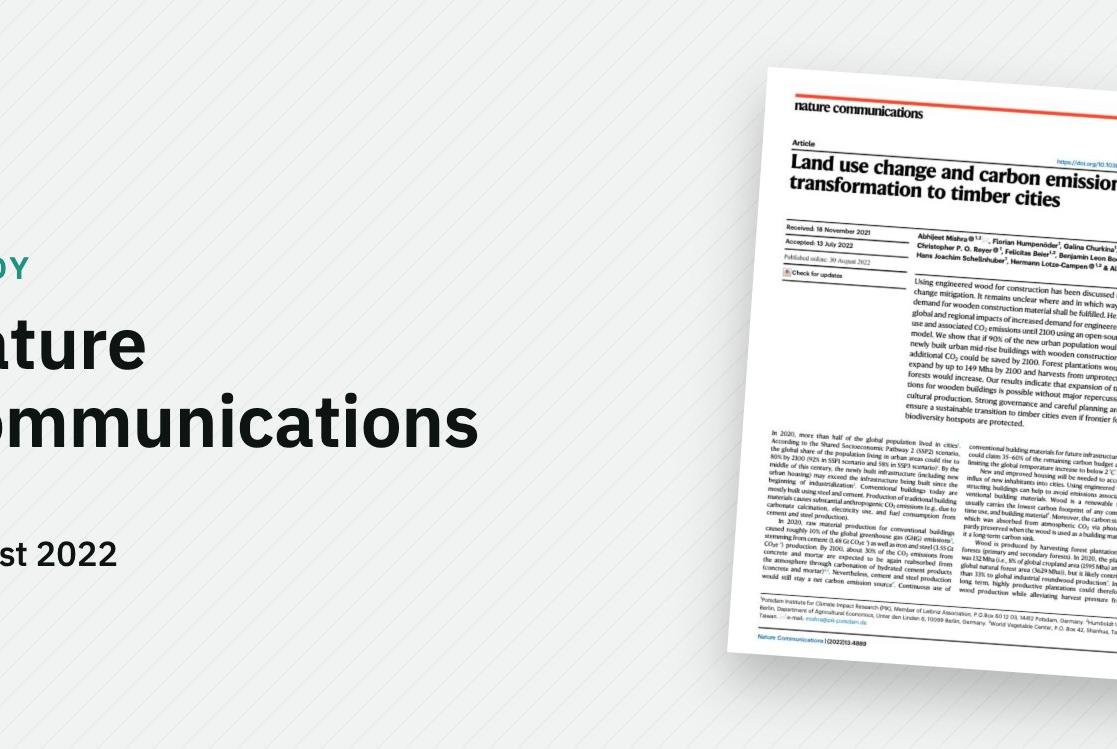
Nature Communications 13 (2022) 4889. Open access, CC BY 4.0
Nature Communications
How would a world of timber cities change land use? Abhijeet Mishra and a team at the Potsdam Institute for Climate Impact Research, including Galina Churkina and Hans Joachim Schellnhuber, modelled this to 2100 with the land-system model MAgPIE.
Authors / institution
Abhijeet Mishra, Florian Humpenöder, Galina Churkina, Christopher P. O. Reyer, Felicitas Beier, Benjamin Leon Bodirsky, Hans Joachim Schellnhuber, Hermann Lotze-Campen, Alexander Popp · Potsdam-Institut für Klimafolgenforschung (PIK) · Humboldt-Universität zu Berlin
Published
2022
Three timber city scenarios
The study compares business as usual with three scenarios in which 10, 50 or 90 per cent of the new urban population lives in mid-rise timber buildings. In the 90 per cent scenario, 106 gigatonnes of CO₂ could be saved by 2100, about 1.3 gigatonnes a year. The buildings themselves would then hold 53 gigatonnes of CO₂.
Forest plantations would need to expand by up to 149 million hectares, and harvests from unprotected natural forests would increase. According to the model, agricultural production would hardly be affected and agricultural prices remain similar across scenarios.
Strong governance and careful planning are required to ensure a sustainable transition to timber cities even if frontier forests and biodiversity hotspots are protected.
Sensitive to how society develops
Under a more sustainable development path (SSP1), cumulative emissions are 42 to 48 per cent lower, and in a fragmented world (SSP3) 17 to 22 per cent higher. The study was published in Nature Communications in August 2022.
How Timber Carbon sees it
The study shows the potential of timber cities and the importance of responsible forest management. More recent work such as Global wood harvest is sufficient for climate-friendly transitions to timber cities shows how demand could be met without a large increase in harvests. Timber Carbon's approach is described on the Technology page.
Full reference: Mishra, A., Humpenöder, F., Churkina, G., Reyer, C. P. O., Beier, F., Bodirsky, B. L., Schellnhuber, H. J., Lotze-Campen, H., & Popp, A. (2022). Land use change and carbon emissions of a transformation to timber cities. Nature Communications, 13, 4889. Open access under CC BY 4.0.
Topics