London Energy Transformation Initiative, January 2020
London Energy Transformation Initiative
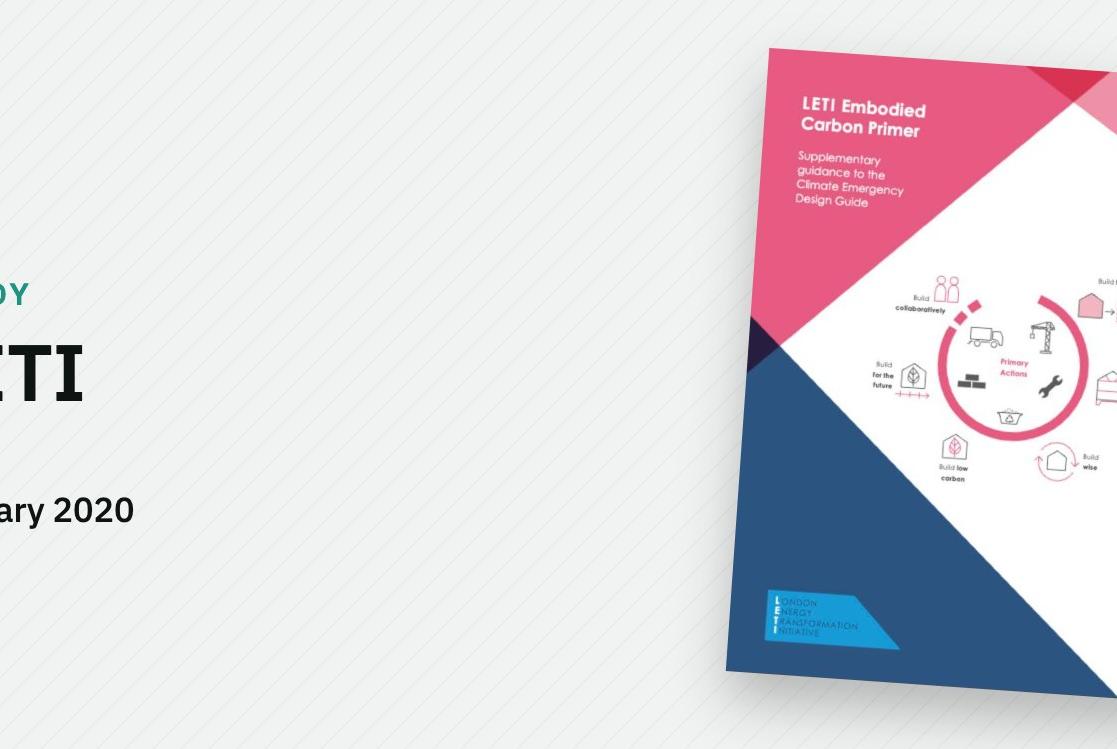
Embodied carbon is often the largest item for new buildings, yet knowledge of how to reduce and calculate it is widely lacking. The London Energy Transformation Initiative (LETI) published the Embodied Carbon Primer in January 2020 as a supplement to its Climate Emergency Design Guide.
Authors / institution
London Energy Transformation Initiative (LETI), Arbeitsgruppe mit rund 40 Fachleuten aus Architektur, Ingenieurwesen, Entwicklung und Planung
Published
2020
A practical guide for designers
The primer is aimed at architects, engineers, interior designers, urban designers and planners. It explains the elements of whole life carbon, defines building archetypes from small residential to schools, and shows for each building element how embodied carbon can be reduced. Seventeen appendices cover client briefing, LCA tools, procurement, rules of thumb and material guides.
Embodied carbon can make up 40 to 70 per cent of a new building's whole life carbon. As best practice, upfront embodied carbon (A1 to A5) should be about 40 per cent below baseline, rising to about 60 per cent by 2030.
In general, the biogenic carbon balance over the life cycle of the wood product equates to 'zero'.
Report biogenic carbon separately
Biogenic carbon in wood should be calculated and reported separately in Module D instead of being deducted from the A to C total, together with the end-of-life stages C1 to C4. About 40 professionals from development, engineering, architecture, planning and academia contributed to the primer.
How Timber Carbon sees it
Reporting biogenic carbon separately matches the logic of Timber Carbon: the carbon removed by the structure is quantified on its own and recognised as a carbon removal credit only after production and construction emissions are deducted. More on the Technology page.
Full reference: London Energy Transformation Initiative (2020). LETI Embodied Carbon Primer: Supplementary guidance to the Climate Emergency Design Guide. London, January 2020.
Topics