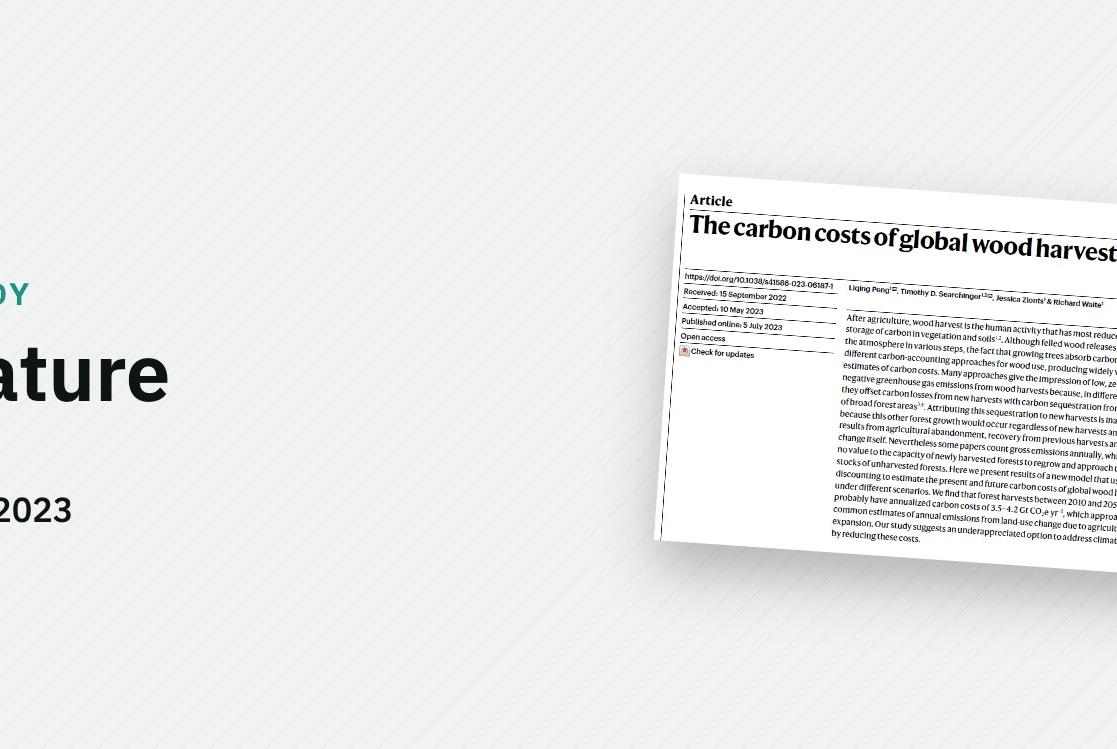
Nature 620 (2023), pp. 110-115. Open access, CC BY 4.0
Nature
Is wood from sustainably managed forests rightly treated as carbon neutral? Liqing Peng and Timothy Searchinger of the World Resources Institute and Princeton University question this and estimate the carbon costs of global wood harvests with a new model.
Authors / institution
Liqing Peng, Timothy D. Searchinger, Jessica Zionts, Richard Waite · World Resources Institute · Princeton University
Published
2023
A model that accounts for time
Many accounting approaches offset emissions from new harvests against the growth of large forest areas. The authors consider this inappropriate, because that growth would happen without new harvests too. Their model values emissions and regrowth over time with a 4 per cent discount rate over 40 years.
Global wood harvests are projected to rise by 54 per cent by 2050. According to the study, harvests between 2010 and 2050 will probably have carbon costs of 3.5 to 4.2 gigatonnes of CO₂e per year, close to emissions from agricultural expansion. About half comes from wood fuel. Long-lived products such as sawn wood and panels account for 22 per cent of the harvested volume.
After agriculture, wood harvest is the human activity that has most reduced the storage of carbon in vegetation and soils.
Substitution with a limited effect
The authors put the benefit of replacing concrete and steel with wood at 0.8 to 0.9 gigatonnes of CO₂e per year. The lowest carbon costs appear in scenarios with half as much wood fuel or with more productive plantations.
How Timber Carbon sees it
The study is an important counterpoint to the use of wood and shows that where wood comes from and how it is used decide its climate balance. Timber Carbon therefore credits only timber in long-lived structures and deducts the baseline and production emissions. The study Global wood harvest is sufficient for climate-friendly transitions to timber cities takes a different view of available volumes.
Full reference: Peng, L., Searchinger, T. D., Zionts, J., & Waite, R. (2023). The carbon costs of global wood harvests. Nature, 620, 110-115. Published online 5 July 2023. Open access under CC BY 4.0.
Topics