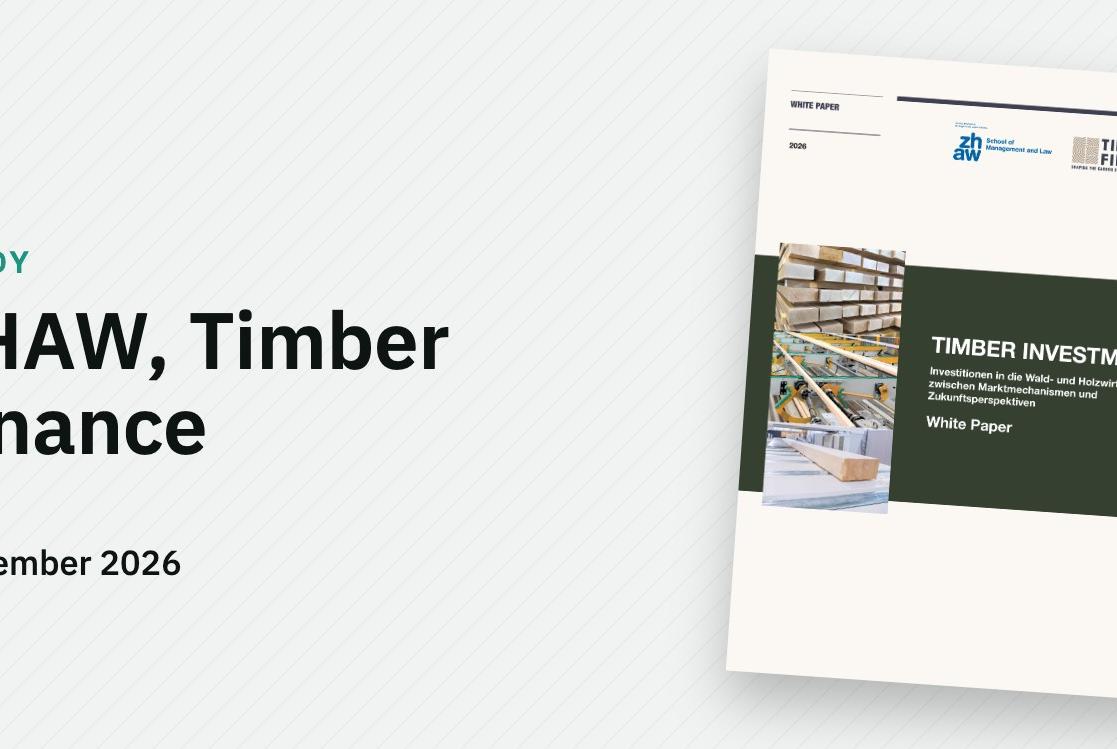
ZHAW School of Management and Law and Timber Finance, 2026 (in German)
ZHAW School of Management and Law, Timber Finance
Forest and timber investments were long seen as defensive value assets. With timber construction and carbon removal, they are becoming a thematic investment. With support from the Swiss Federal Office for the Environment, the ZHAW School of Management and Law and Timber Finance examined what this means for investors.
Authors / institution
Igor Bojic, Andreas Hecht, Nina Lustenberger, Thomas Richter (ZHAW School of Management and Law), Stefano Charrey, Thomas Fedrizzi (Timber Finance)
Published
2026
Large differences between subsectors
An analysis of listed timber companies from 2014 to 2024 shows large differences in capital intensity, profitability, volatility and growth. The highest returns on equity were achieved by more cyclical firms such as wood panel makers, homebuilders, forestry machinery makers and timber distributors, with the widest spread within these groups. Louisiana Pacific achieved stable EBITDA margins of 18 to 26 per cent from 2018 to 2024 with easy-to-install facade elements.
A survey of 41 investors shows basic interest. About 60 per cent consider sustainability important or very important in investment decisions. At the same time, many know little about concrete investment options, and companies rarely report their sustainability performance systematically.
This results in a matching problem between the supply of and demand for capital.
Measurable climate performance as the key
Because of its SME structure, the Swiss forestry and timber industry is only partly investable for many investors. The authors recommend making sustainability performance more measurable and developing instruments such as sustainable loans, thematic funds or SME financing based on the carbon held in timber. Other ecosystem services such as biodiversity, protection forests or water protection could follow.
How Timber Carbon sees it
Measurable climate performance is the precondition for capital to flow into timber construction. Timber Carbon, launched in 2026 as a spin-off of Timber Finance, quantifies the carbon removed by timber buildings and makes it tradable. The Holzrevue article Die Zukunft von Timber Investments also summarises the results. The white paper is available free of charge via a form; its predecessor is the White Paper Timber Financing.
Full reference: Bojic, I., Charrey, S., Fedrizzi, T., Hecht, A., Lustenberger, N., & Richter, T. (2026). White Paper Timber Investment: Investitionen in die Wald- und Holzwirtschaft zwischen Marktmechanismen und Zukunftsperspektiven. ZHAW School of Management and Law and Timber Finance, supported by the FOEN Wood Action Plan (in German).
Topics