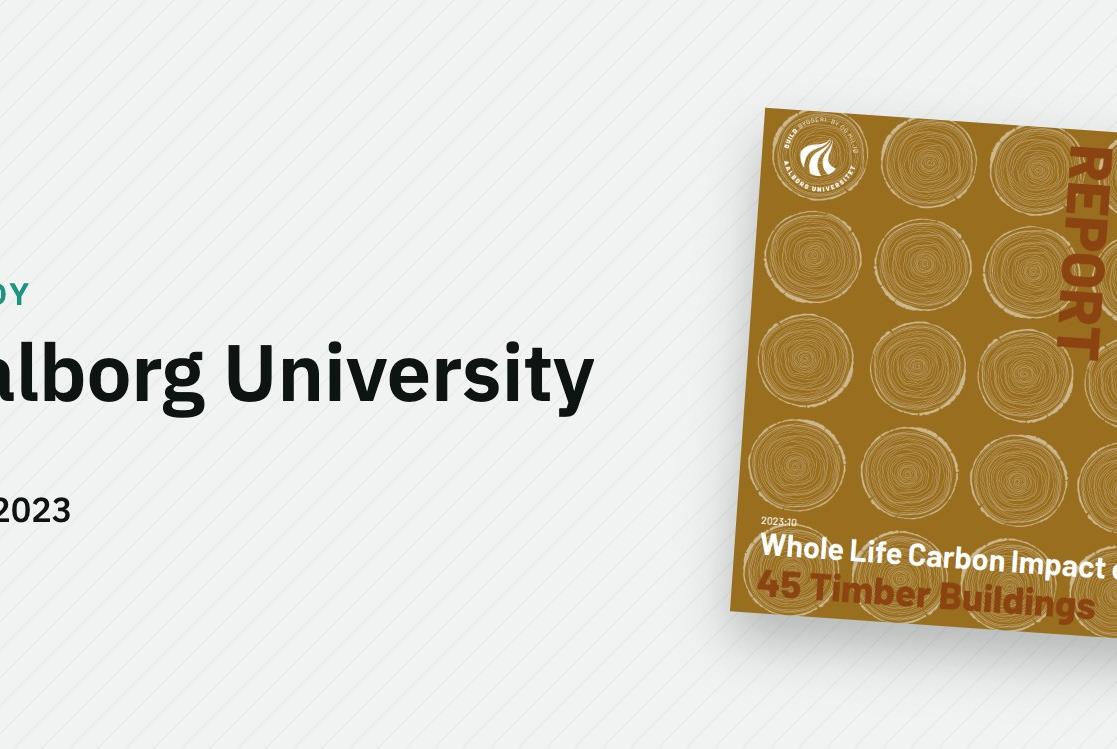
BUILD Report 2023:10, Aalborg University, May 2023
BUILD, Aalborg University
Since 2023, Denmark has set limits on the climate impact of larger new buildings. BUILD, the Department of the Built Environment at Aalborg University, therefore recalculated 45 completed timber buildings and interviewed the people who built them.
Authors / institution
Camilla Ernst Andersen, Agnes Garnow, Christian Grau Sørensen, Alexandra Wittchen, Liv Kristensen Stranddorf, Endrit Hoxha, Freja Nygaard Rasmussen, Harpa Birgisdóttir · BUILD, Aalborg University
Published
2023
Almost all below the limit
The life cycle assessments cover 50 years and are compared with the regulatory limit of 12 kg CO₂e per square metre per year for buildings over 1000 square metres. 41 of the 45 buildings are below it, and 14 also meet the voluntary CO₂ class of 8 kg CO₂e. None of the buildings was specifically designed for a low climate impact.
In every case, materials contribute more than operation. Ground decks, exterior walls, roofs, windows and glass facades account for more than half of the material emissions. The ground deck alone is the largest item in 14 cases.
Lessons from practice
Beyond the numbers, the report documents 35 projects with experience on fire safety, acoustics, moisture on site and financing. The client of a straw-bale house reports, for example, that insurers refused unconventional materials. Architects involved include Vandkunsten and Arkitema.
To reduce the impact from buildings, focus is increasingly on bio-based materials, including wood, since wood will capture CO2 during growth and store it until end-of-life breakdown.
How Timber Carbon sees it
The study shows that timber buildings meet embodied carbon limits even without targeted optimisation. It accounts for biogenic carbon with the -1/+1 method, which offsets uptake and release against each other. The Technology page explains how Timber Carbon quantifies the carbon held long term in the structure.
Full reference: Andersen, C. E., Garnow, A., Sørensen, C. G., Wittchen, A., Stranddorf, L. K., Hoxha, E., Rasmussen, F. N., & Birgisdóttir, H. (2023). Whole Life Carbon Impact of 45 Timber Buildings. BUILD Report 2023:10. Aalborg University, May 2023.
Topics