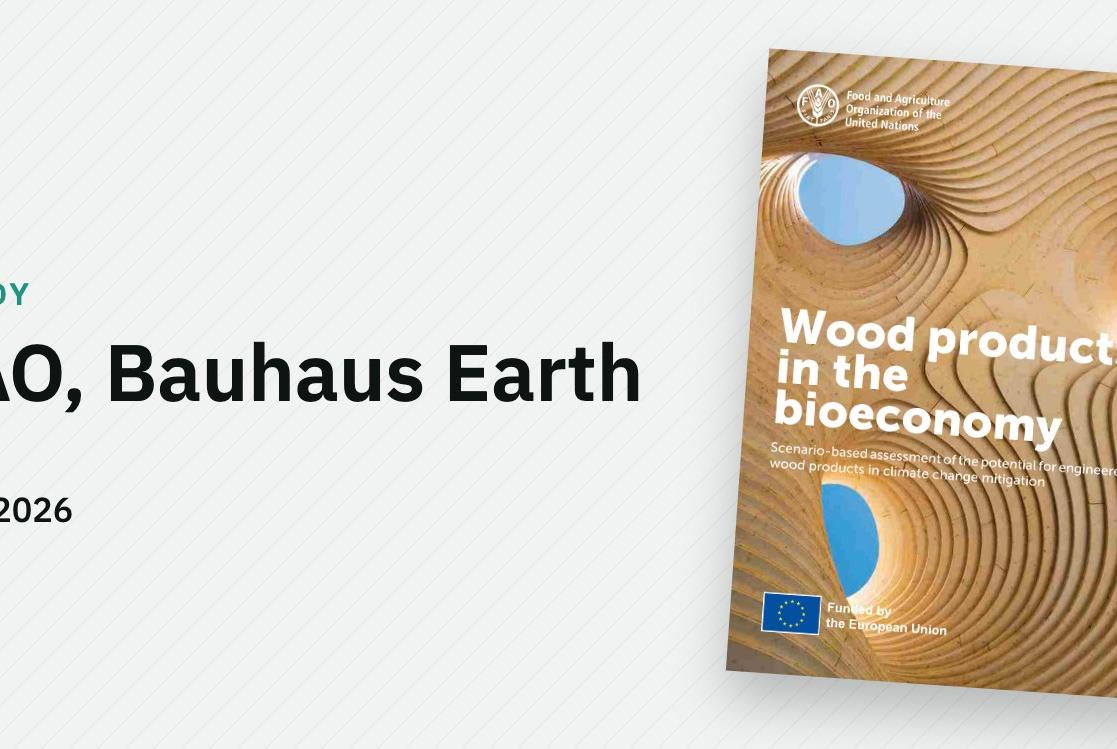
FAO and Bauhaus Earth, Rome 2026. CC BY 4.0
FAO, Bauhaus Earth
More timber in construction is reshaping global wood product markets. A team from the Food and Agriculture Organization of the United Nations (FAO) and Bauhaus Earth uses the Forest Resource Outlook Model to examine how demand, supply and the climate effect of engineered wood products could develop until 2070.
Authors / institution
Barbara K. Reck, Craig Johnston, Adrian Foong, Arushi Gupta, Aleksandr Karpov, Anne Holsten, Philipp Misselwitz, Rodney J. Keenan, Nathalia Formenton Cardoso, Sven Walter, Lyndall Bull, Ashley Steel · FAO · Bauhaus Earth
Published
2026
More demand, new trade flows
The scenarios are deliberately conservative: engineered wood reaches at most 30 per cent in urban housing, compared with 50 to 90 per cent in other studies. Even so, demand rises by 50 to 250 million cubic metres a year between 2030 and 2070. In the medium scenario, Asia would need an additional 40 million cubic metres of coniferous sawnwood in 2050, about 30 per cent more than today, and Africa nearly 20 million, an increase of 165 per cent.
Climate change affects forest productivity unevenly. Under high warming, North America could become a net importer of industrial roundwood while Europe exports more.
Expanded use of EWPs can deliver important global carbon emission reductions.
Carbon held in wood as the main lever
In the medium scenario, global emissions fall by 236 megatonnes of CO₂e a year between 2025 and 2070, or 10.9 gigatonnes in total. That is less than 1 per cent of projected global emissions, and the high adoption scenario achieves 50 per cent more. In all scenarios, the carbon held in wood accounts for at least 61 per cent of the reduction, with substitution making up the rest.
How Timber Carbon sees it
The report confirms that keeping carbon in engineered wood delivers most of the climate effect. This is exactly what Timber Carbon measures in the structure of buildings. More on the Technology page. Bauhaus Earth also published the report Principles for Responsible Timber Construction in 2025.
Full reference: Reck, B. K., Johnston, C., Foong, A., Gupta, A., Karpov, A., Holsten, A., Misselwitz, P., Keenan, R. J., Formenton Cardoso, N., Walter, S., Bull, L., & Steel, E. A. (2026). Wood products in the bioeconomy: Scenario-based assessment of the potential for engineered wood products in climate change mitigation. Rome, FAO. Licensed under CC BY 4.0.
Topics